Tuesday, April 14, 2009

Found type

I was googling for images for another project when I came across loads of cool found type.


Here are more typography photographs from this site. Very cool images.
Another one from the same photographer. The photographer's name is Richard Roche. Love the texture!


This "Pianos" photo from this blog site. I love old, peeled off signs.


3 years ago I had to do a similar project for my Graphic Design class. We had to walk around town and capture images of found type and then make a book out of it. I have no idea where the photos are, and the book is all smashed up... My point is that, everywhere has type! Even if it's not man-made, there is still type. Just look up (if you in a crowded city) and you might just find a letter...

Thanks for that post, Rachel. I never knew this could happen.

Monday, April 6, 2009

Design Matters


Design Matters is a radio talk show broadcasted every Friday from 3–4 p.m. ET. It is hosted by Debbie Millman with a guest designer.

Debbie Millman is the managing partner and president of the design division at Sterling Group, one of the leading branding identity firms in the United States.

The talk show I chose to listen to is the one with Stefan Sagmeister in July 2007. In my earlier blogs I had to listen to one of Sagmeister's "happiness" speech and I found it extremely useful. This talk show with Millman is also about how to be happy and perhaps change to be happy.
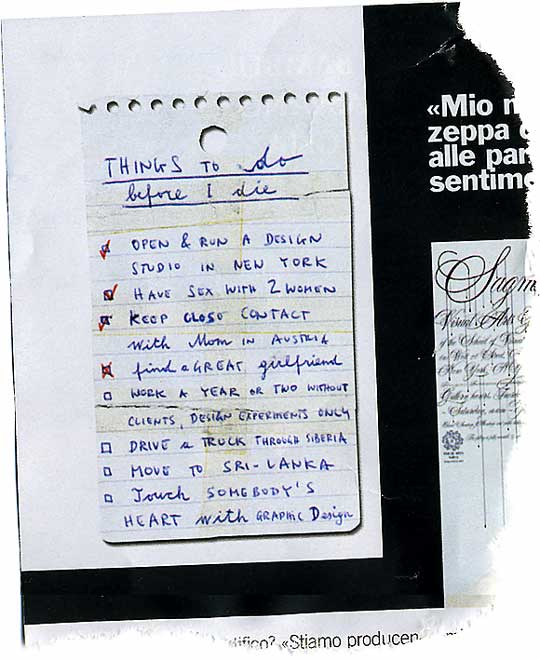
She mentioned one of his AIGA postcards that she just loves very much. It was a list of things Segmeister wants to do before he dies. It's in rough handwritings on a piece of torn (and dirty) notebook paper. It is quiet interesting. Segmeister is so great at using handletterings. Too cool.


Millman's introduction of Sagmeister was his 1999 AIGA poster. I guess he really marked himself (and his assistant) the letterings on his body using an xacto knife... I can't imagine he was happy when he was doing it...


The more I learn about Sagmeister the more I am inspired to do something good (to the public and to myself). If you're happy, your work will show.
I think today design students (myself also) use the computer too much. Everything designed seem to be computer generated and it is aweful. Maybe that's why I like Sagmeister's work so much because he uses real actual things to make type and projects. I stumbled upon one of his posters and I find absolutely in awe and beautiful—posters for Levi jeans. It was given away free if you buy a pair of Levi jeans. What Segmeister did was to actually shread the jeans up into its parts... Again, very cool.


For Segmeister, to be able to come up with ideas when the deadline is still far away with no pressure makes him happy in design. And traveling (and driving a motocycle without a helmet somewhere...) makes Segmeister happy in life.

I think it is important for us, as designers, to be able to be happy with our design and our life.
And to finish off this blog, I'm quoting one of Millman's guide to her personal happines that she mentioned at the beginning of the talkshow:
"People are like plants; they need a lot of water."
First, I don't drink enough water, so I have to bear this in mind. But second, and more importantly, is that people like plants need care, nutrients, and the sun; for designers to grow, we need understanding/learn/acceptance of others strength and weaknesses, expand our knowledge, and a creative source... That's what I think and will try to remember.

For other podcasts, here's the link to both the podcast list and the live show link.
(I didn't think they'd have commercial, but... they do.)

Sagmeister’s full list of 20 maxims in his book Things I Have Learned In My Life So Far:
1. Helping other people helps me.
2. Having guts always works out for me.
3. Thinking that life will be better in the future is stupid. I have to live now.
4. Organising a charity group is surprisingly easy.
5. Being not truthful always works against me.
6. Everything I do always comes back to me.
7. Assuming is stifling.
8. Drugs feel great in the beginning and become a drag later on.
9. Over time I get used to everything and start taking for granted.
10. Money does not make me happy.
11. My dreams have no meaning.
12. Keeping a diary supports personal development.
13. Trying to look good limits my life.
14. Material luxuries are best enjoyed in small doses.
15. Worrying solves nothing.
16. Complaining is silly. Either act or forget.
17. Everybody thinks they are right.
18. If I want to explore a new direction professionally, it is helpful to try it out for myself first.
19. Low expectations are a good strategy.
20. Everybody who is honest is interesting.

Tuesday, March 31, 2009

John Maeda


Wow. He is a pretty cool and smart person!

John Maeda is currently the president of the renowned RISD (Rhode Island School of Design), appointed to that position just last year in 2008. Maeda was also the Associate Professor of Media Arts and Science at MIT (Massachusetts Institute of Technology).

As a computer science student at MIT, Maeda was torn between his passions for both computer science and arts. One day, his instructor Muriel Cooper persuaded Maeda to follow his arts & design dream. And good thing she did because Maeda is truly a great designer and his teachings/thoughts really change one person's point of view on design.

He went on and got both his BS and MS degrees from MIT and PhD in Design at Tsukuba University Institute of Art and Design in Japan. He's written books on computer media designs and his most recent book was The Laws of Simplicity.

The Laws of Simplicity outlines 10 rules of simplicity. Some are contradicting the other rules, so what really are the laws? Or is there even one definite rule to simplicity? If Maeda can't even be sure of it, then I doubt I can. However, his 10 rules are pretty good "guidelines" to want to make simple things/designs.
If I have to live by one of his rules, it would be "Simplicity and complexity need each other." This statement really says it all—the whole simplicity business is not really simple and nothing can live without it's opposite. So in a design, it needs to have both simple and complex information.

Perhaps to make a good design it need to achieve a balance in simplicity and complexity, or maybe not, because that might be too harmonious and prove to be too boring...
Then again, one person might see one thing in simple whereas another sees it very complicated.

I don't know what to say now. My thoughts are both simple and yet too complicated to even describe them in words... Anyhow, Maeda is a very important contributor in the 21 c. He didn't get those honorary awards for nothing, you know.

He's pretty funny too, which makes him even more interesting. Here's a speech he gave for a TED conference and I enjoyed it immensely.

Sunday, March 29, 2009

Pretty Cool Type Animation

Title sequence from Jeff Schaffer's 2004 film "Eurotrip." The title sequence is designed by http://www.prologuefilms.com. Video by MovieTitleSequence on YouTube.

Thursday, March 26, 2009

Great Speech Type Animation


I'm doing the "First promotional message recorded on an Edison Phonograph" by Len Spencer.

The speech is important because it was the first promotional message recorded on a phonograph, therefore giving something new, fresh, and interesting for the audience. I can just imagine regular people listening on the radio in 1906 and see their exciting faces! Anyway, it was an important step in history and that's why it's important and interesting.

Len Spencer has a pretty good voice. The speech is a little blurred, not very crisp like our digital recordings today, but hey, it was recorded in 1906 on the Edison phonograph, give it some credit. Spencer's tone throughout the whole speech is dreamy and also exciting. He used a first-person narration—"I" was the Edison phonograph—so it was more interesting. He was promoting something new, and since it was an advertisement, he emphasized a lot on what "I" can do. That's why I think it has a dreamy quality... like having the phonograph can solve all your problems. "I can love...", "I can give...", I can aid..." and I had to giggle when I heard "I give pleasure to all, young and old." I thought, "Wow! I wish I can have a phonograph."

After listening the speech, it made me want to buy a phonograph, so it can solve all my problems... and do all my homeworks...


Short bio on Len Spencer

Born in Washington D.C. on January 12, 1867, Len Spencer became one of the earliest stars of recorded music. He was a rising star on the vaudeville circuit when Thomas Edison created his wax cylinders as a way to capture sound. Originally conceived as a helpful dictation tool, Edison and others soon realized the broader applications to the cylinder, most notably in the realm of entertainment.

Spencer was hired by Edison to help promote his retooled invention, and created the first recorded promotional advertisement in 1888 for the "genuine Edison phonograph." Spencer recorded hundreds of songs on cylinders for Edison and Columbia (the Washington-based recording company that evolved over time into the huge Columbia Records company, now part of the Sony conglomerate), including "Little Liza Loves You" in 1891, one of the best selling cylinders of all time.

He was also one the first white performers to record with an African-American artist, George Johnson. Johnson had an enormous hit wax cylinder in the mid-1890s with his number, "The Laughing Song," which—because of the inability to mass produce wax cylinders—forced him to sing the song several thousand times over. He re-recorded the song with Spencer on metal cylinders and sold thousands more, and began a lifelong friendship with Spencer.

Spencer's early recorded output included best-sellers like the "Lord's Prayer" and speeches by famous public figures, including a posthumous release of President McKinley's speech at Buffalo's Pan-American Exposition in 1901, the day he was assassinated. Spencer was well-known for clear diction and rich baritone, and became a master at comic dialects, recording dozens of songs with vaudeville star Ada Jones, using Italian, Irish, German, Jewish, African American and rural American voices to comedic effect.

In 1902, he recorded the already well-known novelty tune "Arkansas Traveler" onto a 78 rpm disc with banjo great Fred Van Eps and fiddler Charles D'Almaine, and was a national star after it became the first song to sell more than a million copies. The invention of the recorded disc a couple of years earlier by Emile Berliner (also in Washington D.C.) greatly facilitated the mass production of recordings, and Spencer was among the first to benefit. He recorded many sides for the Berliner Gramophone Company in Washington, and for all the other recording companies of the time (Columbia, Victor, etc.) including "A Cowboy Romance" and "A Hot Time in the Old Town Tonight," as well as songs by budding composers George M. Cohan and Irving Berlin.

He moved to New York where he continued to perform and where he founded an artist booking agency, The Lyceum (which employed Spencer's old friend George Johnson as the doorman, working dressed as an admiral). He died in New York in December 1914.

I'm excited to do this project, but I wish we can have more time to do it. It's my first After Effects project (and for most of us in class) so it should be... um... interesting.

Tuesday, March 24, 2009

Stop Stealing Sheep - Chapter Summaries

"Stop Stealing Sheep & find out how type works" by Erik Spikerman and Ginger provides a really good intro and summary for how to use type.

Chapter 1 - Type is everywhere
An intro to type in our everyday lives and explains why type is important to everyone.

Chapter 2 - What is type?
Provides a short history of type and how typography will never stop existing.

Chapter 3 - Looking at type
Provides a good intro to the many different type styles and explains why they work for certain emotions, time period, and events/places...

Chapter 4 - Type with a purpose
Different typefaces have different purposes; for example, script fonts for elegant events like weddings. This chapter also gives the explanation for their functions.

Chapter 5 - Type builds characters
Every typefaces have their own character, mood, style, and personality. It is important to know so we can use them to express the right message.

Chapter 6 - Types of type
Provides an extended summary of the kinds or typefaces are available today and the reasons for the many subtle differences within a type family.

Chapter 7 - How it works
Teaches how to use them correctly for the best results. Many technical aspects of using type is summarized in this chapter.

Chapter 8 - Putting it to work
Reasons and examples of how type should be used in layouts for different applications.

Chapter 9 - There is no bad type
A summary of the book. Type is ever-changing; it evolves to fit the current trends and purposes. What was once a good type is a bad type now, and vice verse. There will also be new typefaces.

Good is... videos

Good is. is a very cool site. The videos are great and funny! And the rest of the site is very graphically interesting. Just too cool (I new some new vocabularies, I keep say this throughout my whole blog site...)

What I especially liked about the site is it always uses unexpected content within a context. I think as graphic designers we need to do this more often, or do it well whenever it's done. It can be hard to think of something out of the ordinary, but that's what sets us apart (the good and bad ones). Also, sense of humor is very important, which Good is. uses a lot.

Visit their site at www.good.is or just click here!